
Learning quality cannot be assured through policy. It requires a shared framework.
When faculty and academic leaders operate without a common standard for course design, every program carries its own quality level. Some courses are excellent. Others are not. And no one can systematically explain the difference - or close it.
The problem
At-risk students are typically identified late in the semester. By then, intervention is no longer meaningful.
The data to identify them earlier is already in your LMS. What's missing is the capability to read it.
That same gap exists in course design. The majority of active courses at most institutions use no documented, evidence-based design framework. Faculty teach the way they were taught, without a feedback loop connecting their pedagogical decisions to actual learning outcomes. Quality depends on who is in the room - not on how the institution has designed the process.
When those capabilities are underdeveloped, the gap shows up in accreditation reviews, in programs that fail to demonstrate outcomes, and in students who don't get the support they needed early enough to matter.
Who Enrolls
This academy serves two distinct audiences. Clarity on which track your institution needs is established before program design begins.
For curriculum specialists, instructional designers, and program coordinators
Addresses how pedagogical processes are designed, systematized, and scaled across the institution. The outcome is operational: a shared framework your institution governs, not a collection of individual practices.
For professors, instructors, and academic leads
Addresses how teaching practice is designed, how evidence is used, and how learning is made intentional rather than intuitive. The outcome is pedagogical: faculty who read learning signals and adjust, rather than faculty who teach and hope.
What your team builds
Participants don't attend lectures on learning theory. They redesign the courses and programs they are currently responsible for.
Staff track participants redesign at least one active program using our proprietary framework - documented, aligned, and presented at Demo Day as an institutional proposal leadership can formally adopt. Faculty track participants redesign a course unit with explicit evidence-based architecture, mapped against a shared rubric from program entry.
Example of deliverables
Redesigned program
A course or program rebuilt using own framework, with learning outcomes aligned to assessment, documented for institutional adoption
Evidence-based course unit
A redesigned unit with explicit pedagogical architecture, evaluated against a rubric shared at program entry - not revealed as a surprise at Demo Day.
Institutional proposal
A formal presentation to academic leadership at Demo Day. Staff track proposals are built to be adopted as institutional standard. Faculty track work is evaluated against pre-shared criteria.
Future Education Sandbox
Where the work actually happens.
The Sandbox is Future Education's proprietary learning environment. It is where every cohort works - not a platform you buy, but the structured environment we bring to every program we run.
Think of it as the campus. The Academies are the programs. The Sandbox is where participants do the real work, supported by a facilitator and an AI mediator that helps them think - not one that thinks for them.
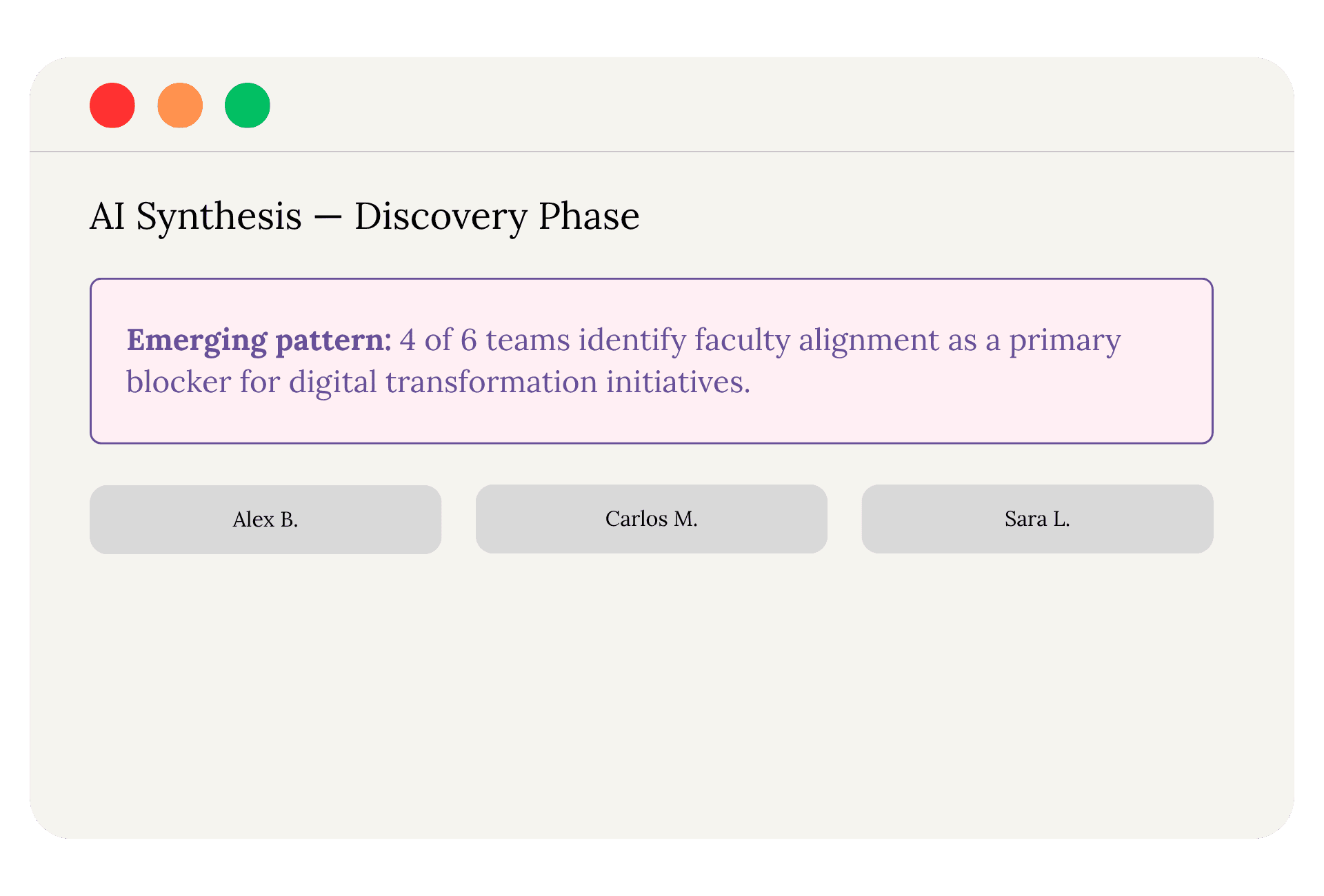
The Sandbox AI mediator never produces content for participants. Its role is to surface questions, challenge assumptions, and return the work to its institutional context.
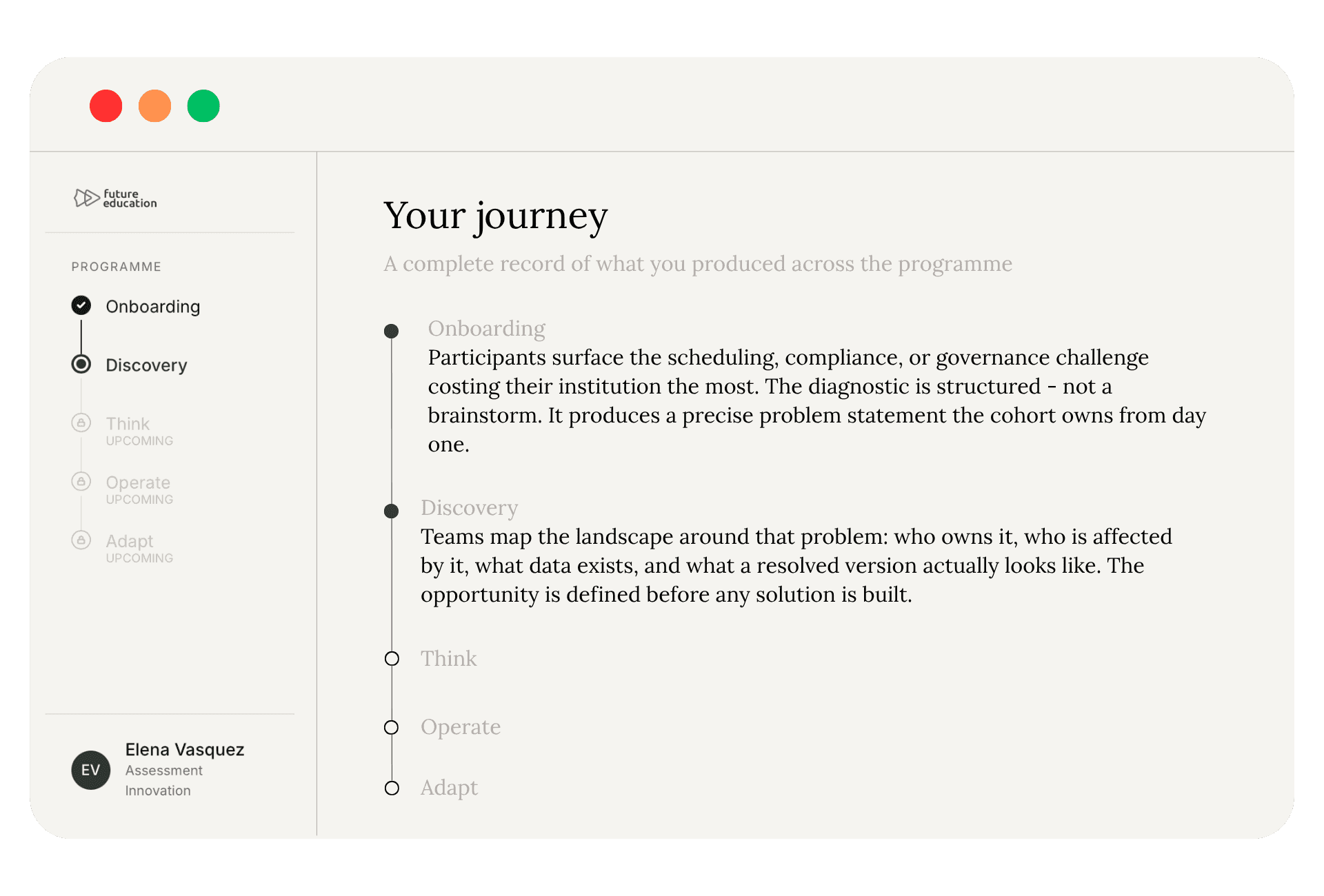
We offer two delivery formats: fully remote or a hybrid blend of online and in-person sessions.
Inside every program
Real work.
Expert guidance.
Full visibility.
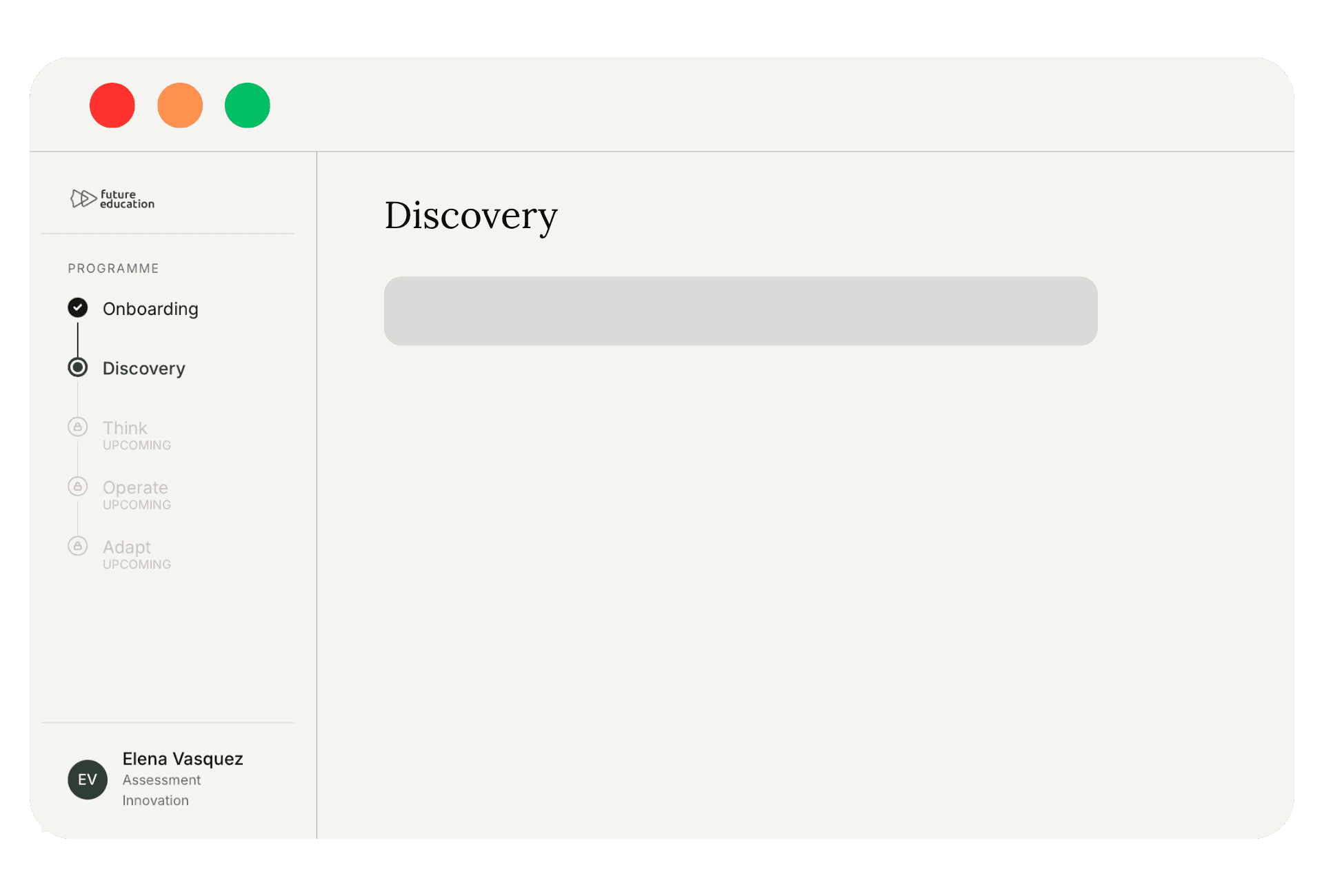
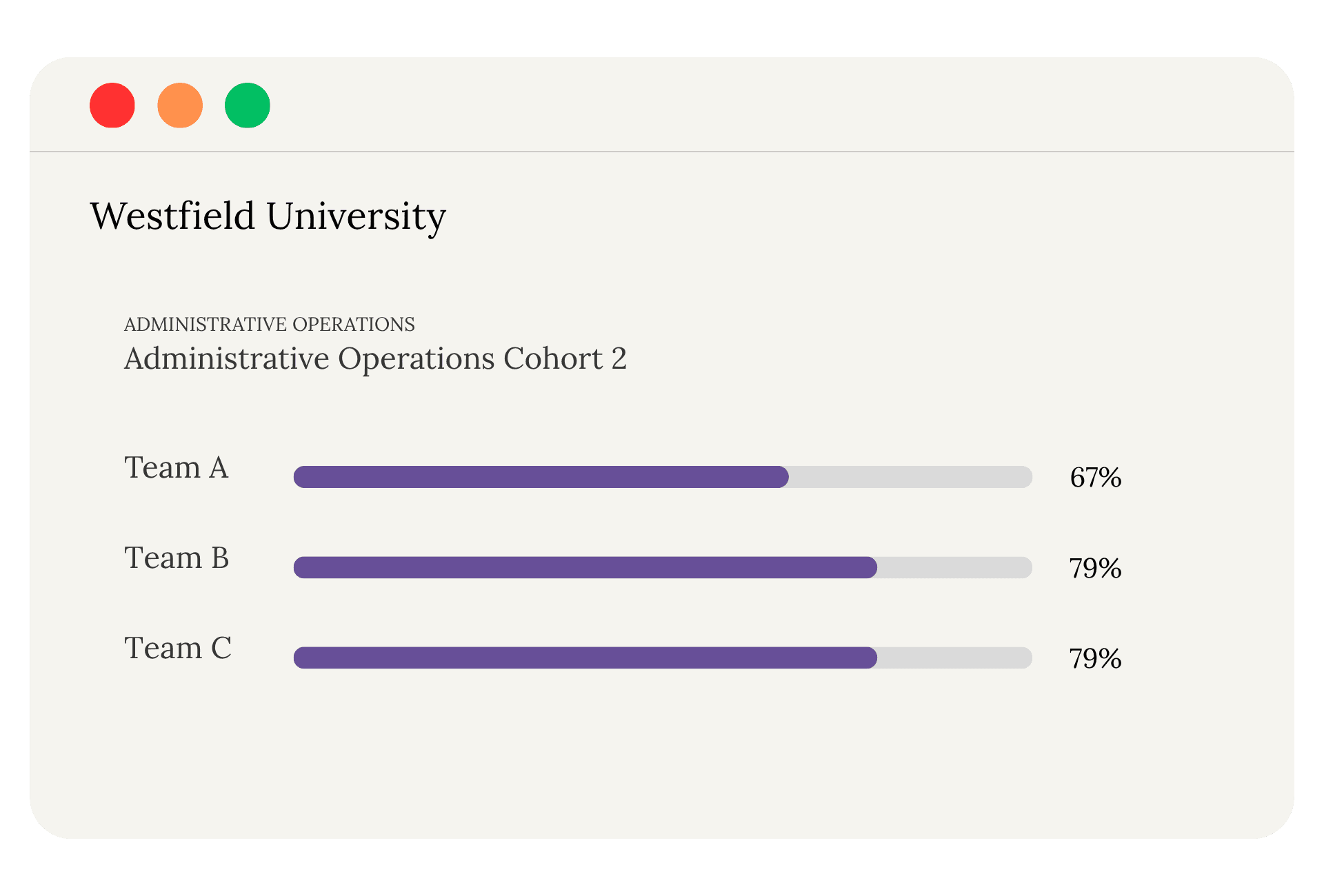
Future Education programs are not self-paced learning. Each cohort has a dedicated facilitator, a structured progression, and clear visibility for institutional leadership throughout. Every role has a defined function - and the work only moves when each one is doing theirs.
Why Future Education
Every program delivered across the academies carries the competencies as its quality standard. It is not a module. It is a permanent mindset architecture woven into how professionals learn, practice, and operate. Staff leave not just with new skills, but with a new way of seeing their work.
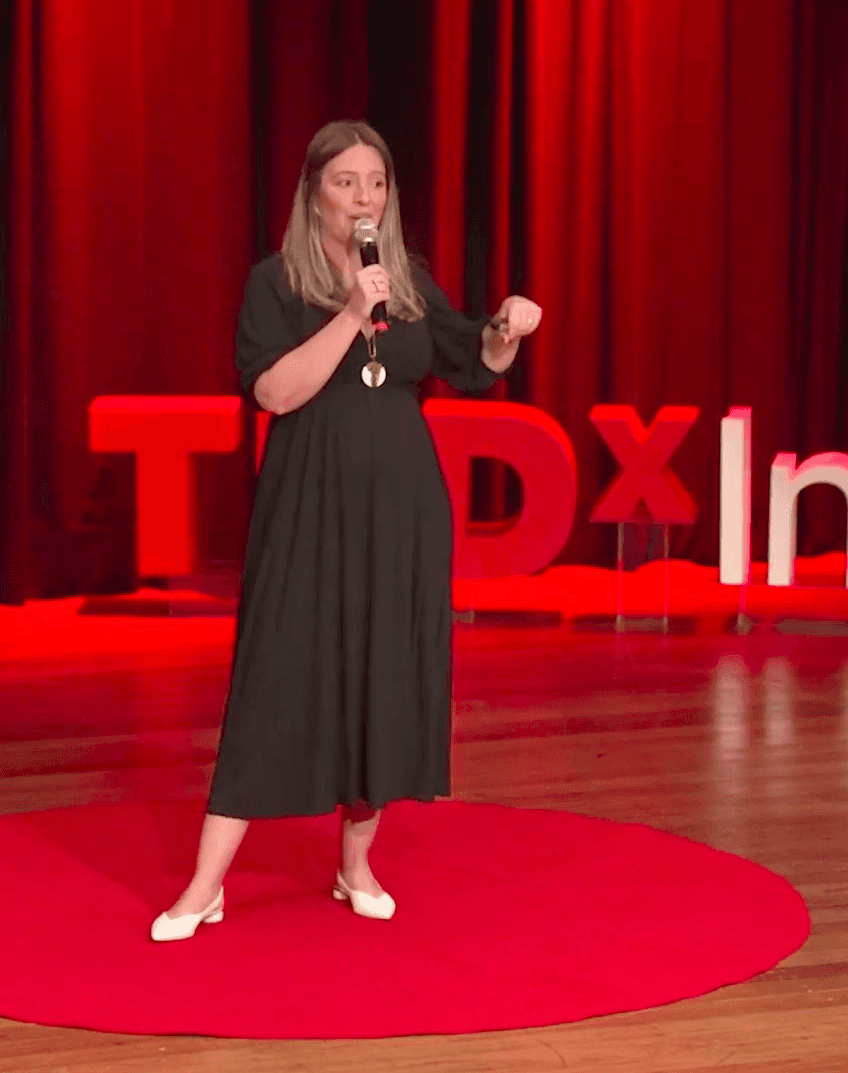
"After two decades in academic leadership, I believe in empowering people to transform their practices through systems of continuous improvement."

Prof. Msc. Juliana Mazzi
Founder of Future Education and Former Associate Dean
Some of your courses are excellent. Others are not. Do you know which - and does your institution have a way to close that gap?
Fill out the form, and let’s talk about how we can support your institution with tailored learning solutions.
Start with one academy
By submitting this form you agree to our Privacy Policy. Optimum may contact you via email or phone for scheduling or marketing purposes.